
An adult who refuses recommended treatment is a classic scenario for the communication and ethics stations of MRCPI Part II Clinical and MRCP(UK) PACES. The examiner is not testing whether you can persuade the patient. They are testing whether you can assess capacity for this decision, at this time, using the right legal test, and then respect the answer. This walkthrough uses the Mental Capacity Act 2005 (MCA) for England and Wales and the Assisted Decision-Making (Capacity) Act 2015 (ADMCA) for Ireland, with General Medical Council (GMC), Medical Council of Ireland and Health Service Executive (HSE) guidance [1–14]. Scope: the UK law here is England and Wales only; Scotland and Northern Ireland have different legal frameworks [7].
The rule: presume capacity, support the decision, test the four abilities for this decision only, and remember that an unwise refusal is not proof of incapacity [1, 7, 9, 13].
The Weekly Bedside: one free high-yield clinical exam lesson by email every week. Subscribe free →
The candidate brief
You are the medical registrar on call. Mr Declan Murphy is a 67-year-old retired electrician admitted this afternoon with community-acquired pneumonia and sepsis. His chest X-ray shows right lower lobe consolidation. He is febrile, his blood pressure remains low after initial fluids, and his blood tests show raised inflammatory markers and a raised lactate. The team strongly recommends admission and intravenous (IV) antibiotics. He has told the nurse he is going home tonight because nobody else can look after his dog. Please speak to him, assess his capacity to refuse treatment and agree a plan. You do not need to examine him.
Mr Murphy is fictional. The same structure works for any refusal: an endoscopy, a blood transfusion, a lumbar puncture or self-discharge.
Before you go in: pre-meeting checks
- What exactly is being refused? Be clear on the recommended treatment, any alternatives and their limitations (here, inpatient IV treatment remains the strongly recommended option) and the likely consequences of each, including the consequence of doing nothing. This is the “relevant information” the patient must be able to understand [2, 8].
- Why now? Has anything prompted doubt about capacity? HSE policy is explicit that capacity should not be called into question without reasonable grounds, such as a decision that risks significant harm, is out of character, is inconsistent, or seems clearly irrational [12].
- Reversible barriers: pain, fever, hypoxia, hearing aids, glasses, language and the need for an interpreter, timing of sedating drugs. “All practicable steps” to support the decision come before any finding of incapacity [1, 9].
- Advance decisions or directives: ask the team and the patient whether one exists, and whether anyone holds legal authority for health decisions [4, 10, 13].
- Setting: a quiet room, a nurse present if the patient agrees, and time protected from interruptions.
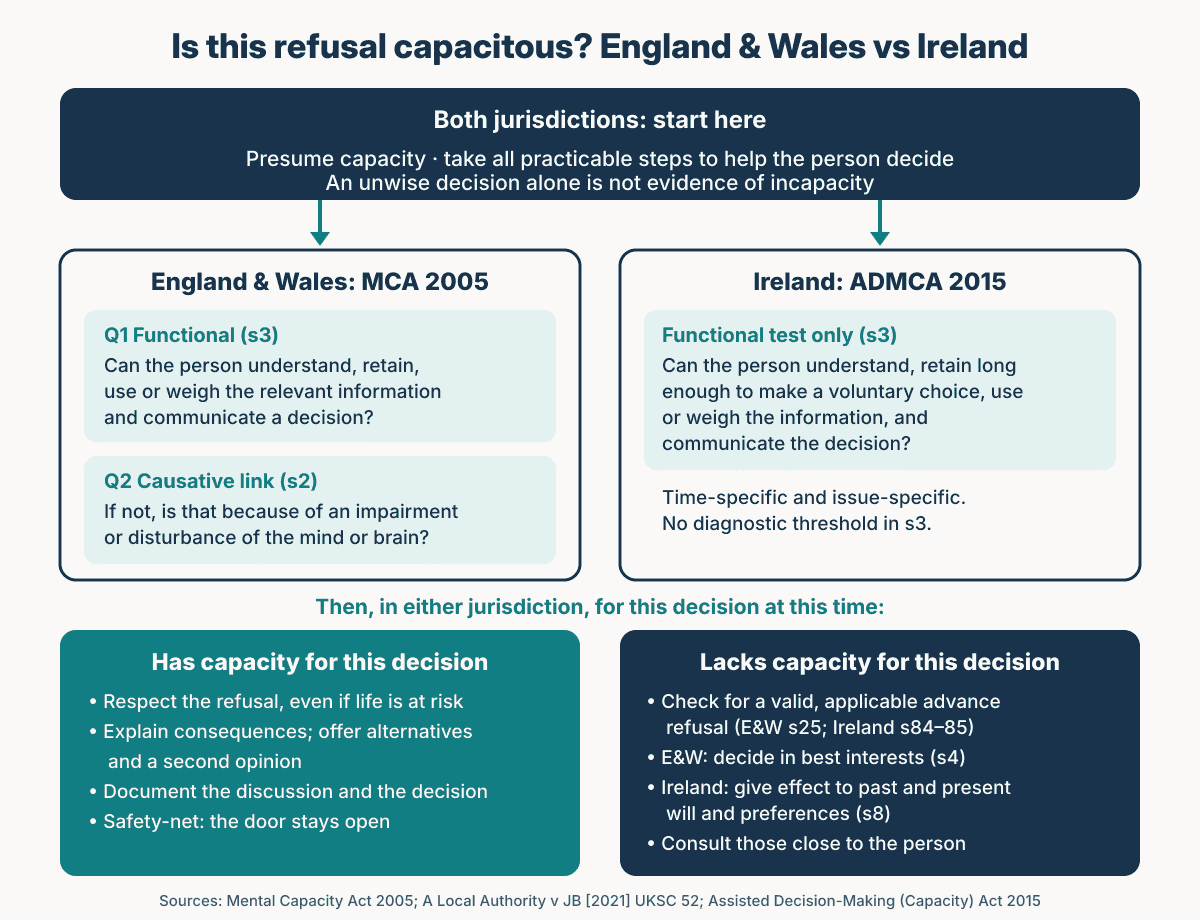
The capacity assessment at a glance
The conversation, step by step
1. Open and explore
Introduce yourself, confirm his name and check he is comfortable to talk. Start with his perspective before giving any information.
- “I hear you’d like to go home tonight. Can you tell me what’s on your mind?”
- “What do you understand about why the team wants you to stay?”
Listen for the real concern. Here it is the dog, and a practical problem may have a practical solution.
2. Give the information in chunks
Explain the diagnosis, the recommended treatment, the alternatives and the likely consequences of each choice, including refusing. Use plain language and check understanding after each chunk. A person is not unable to understand if they can understand an explanation given in a way that suits them, for example in simple language or with visual aids [2, 8].
- “Your chest X-ray shows a pneumonia, and your low blood pressure and your blood tests show the infection is affecting your whole body. That’s called sepsis.”
- “Our advice is to stay so we can give antibiotics through a drip and keep a close eye on you. If you go home, the infection could get worse quickly, and it could become life-threatening.”
3. Assess the four abilities
Assessing capacity is a core clinical skill and does not usually need a specialist [7]. Test each ability explicitly; the statutes and the HSE policy describe the same four functional abilities [2, 8, 12].
| Ability | Model question | What a pass sounds like |
|---|---|---|
| Understand | “In your own words, what is wrong and what are we suggesting?” | “It’s a chest infection that’s got into my blood. You want me in for drip antibiotics.” |
| Retain | Return to it a few minutes later: “Remind me what could happen if you go home?” | He recalls the risk long enough to decide. Short retention does not, by itself, mean incapacity [2, 8]. |
| Use or weigh | “How are you balancing the risks against getting home to your dog?” | He engages with the trade-off, even if he weighs it differently from you. |
| Communicate | “So what have you decided?” | A clear, consistent choice by any means: speech, writing, gesture or assistive technology [2, 8]. |
In England and Wales, if he fails any limb, ask the second question: is that inability because of an impairment of, or a disturbance in the functioning of, the mind or brain? The Supreme Court held that the functional question comes first and the causative link second [2, 5]. In Ireland, section 3 of the ADMCA is a purely functional test, and capacity is assessed for a particular decision at a particular time [8]. In both, the decision is made on the evidence; the MCA specifies the balance of probabilities [2].
4. Explore reasons and offer alternatives
If a choice seems out of keeping with the patient’s values, it is reasonable to check his understanding and offer further support rather than conclude he lacks capacity [7]. Then negotiate around the real problem.
- “If we could arrange for a neighbour or a friend to look after the dog tonight, would that change things for you?”
- “My strong advice is still to stay tonight. If anything else is making that hard, tell me and we’ll try to sort it out.”
5. Respect a capacitous refusal
If he has capacity, his decision stands, even if you disagree with it [7, 13] and even if it may result in his death [12]. Say so clearly and without pressure.
- “It’s your decision, and I respect it. I’d still like to make going home as safe as possible.”
- Offer a second medical opinion if he would like one [13].
6. Safety-net and document
- Make clear that inpatient treatment remains strongly recommended and that he can change his mind and return at any time. Any harm-reduction plan for discharge (what treatment he will accept, review arrangements, warning symptoms and how to return) must be individualised, based on a senior clinical assessment of his current condition, and documented. It is not an equivalent alternative to admission.
- Document what was offered, the information given, your assessment of each ability, his reasons, his decision and the safety-net plan [12, 13]. Inform the general practitioner (GP).
7. If he lacks capacity for this decision
- Check for a valid and applicable advance refusal. For life-sustaining treatment both jurisdictions require the refusal to state that it applies even if life is at risk [4, 10].
- England and Wales: act in his best interests, consider whether he is likely to regain capacity, involve him as far as possible, consider his wishes, feelings, beliefs and values, consult those close to him and choose the least restrictive option [1, 3, 7].
- Ireland: any intervention must be necessary and proportionate, and must give effect, as far as practicable, to his past and present will and preferences, beliefs and values [9]. Consult those he has named and anyone with formal authority under the Act [9, 10, 11].
- Emergencies: urgency never overrides a capacitous refusal. England and Wales: if you have taken reasonable steps to assess capacity and reasonably believe he lacks it, treatment in his best interests is protected by section 5 of the MCA, which does not override a valid and applicable advance decision [3, 4, 14]. GMC guidance limits emergency treatment to what is immediately necessary to save life or prevent a serious deterioration, choosing the least restrictive option [7]. Ireland: HSE policy allows treatment without consent in a serious emergency unless you know of a valid and applicable advance healthcare directive refusing it, and any intervention must be necessary and proportionate under the Act [9, 10, 12].
- Reassess as his condition changes: capacity is time-specific [7, 8].
England and Wales vs Ireland compared
| Issue | England and Wales | Ireland |
|---|---|---|
| Statute | Mental Capacity Act 2005 [1] | Assisted Decision-Making (Capacity) Act 2015, commenced 26 April 2023 [11] |
| Presumption of capacity | Yes, s1(2) [1] | Yes, s8(2) [9] |
| Unwise decision | Not, by itself, evidence of incapacity, s1(4) [1] | Not, by itself, evidence of incapacity, s8(4) [9] |
| Test | Functional inability, caused by an impairment or disturbance of the mind or brain, ss2–3 [2, 5] | Functional test only, s3; time- and issue-specific [8] |
| If capacity is lacking | Best interests, s4 [3] | Necessity, proportionality, and past and present will and preferences, s8 [9] |
| Advance refusal of life-sustaining treatment | Advance decision in writing, signed, witnessed, stating it applies “even if life is at risk”, s25 [4] | Advance healthcare directive with a statement that it applies even if life is at risk, s85(3) [10] |
| Professional guidance | GMC Decision making and consent (2020) [7]; MCA Code of Practice [6] | Medical Council Guide, 9th edition (2024) [13]; HSE National Consent Policy [12] |
Scotland and Northern Ireland have their own mental capacity legislation, and the GMC expects doctors to know the law and code of practice wherever they work [7]. For a related station on ceilings of treatment, see DNAR: when the family says “do everything”.
Red flags and common errors
- Equating disagreement with incapacity. An unwise choice is not evidence of incapacity in either jurisdiction [1, 9].
- A global label. “Lacks capacity” without naming the decision and the time is meaningless; capacity is decision- and time-specific [7, 8].
- Skipping support. Declaring incapacity before treating fever, pain or hypoxia, or before getting an interpreter or hearing aid [1, 9].
- Assuming from diagnosis, age or appearance. The MCA and GMC both prohibit it [2, 7].
- Coercion. Threats, exaggerated risks or repeated pressure undermine a voluntary decision.
- Treating relatives as decision-makers. Consult them, but decisions rest with the patient or with someone with legal authority [3, 9, 10].
Examiner questions
- How do you assess capacity? Presume capacity, support the decision, then test whether the patient can understand, retain, use or weigh the relevant information and communicate a decision; in England and Wales, also establish whether any inability is caused by an impairment or disturbance of the mind or brain [1, 2, 5, 8].
- Who should assess it? The doctor proposing the treatment can usually do so; it is a core skill. Seek specialist input in complex cases or when the patient or family disagree with your judgement [7].
- The patient’s decision seems irrational. Does that mean he lacks capacity? No. It may be a reason to check understanding carefully, but an unwise decision is not, by itself, evidence of incapacity [1, 7, 9, 12].
- What makes an advance refusal binding? It must be valid and applicable to the treatment and circumstances. For life-sustaining treatment it must say it applies even if life is at risk; in England and Wales it must also be written, signed and witnessed [4, 10].
- How does Irish law differ from the MCA? The ADMCA uses a purely functional test and gives effect to the person’s will and preferences rather than a best-interests standard. It also introduced formal decision supports, with a new Decision Support Service, and replaces adult wardship [8, 9, 11].
Hypothetical example summary
“I spoke with Mr Murphy, a 67-year-old man with community-acquired pneumonia and sepsis who wished to go home tonight. His main concern was the care of his dog. I explained the diagnosis, the recommended IV antibiotics and admission, the alternatives and the risk of deterioration and death if he left. He could explain this back in his own words, recalled it later in the conversation, weighed the risks against his reasons and communicated a consistent decision. I found that he has capacity for this decision at this time. After we arranged care for his dog, he agreed to stay. Had he still declined, I would have respected his decision, made clear that admission remained strongly recommended, agreed an individualised harm-reduction plan with senior input, safety-netted and documented the assessment in full.”
Exam Take-Home Pearls
- Capacity is decision-specific and time-specific: always name the decision and the time [7, 8].
- Presumption, support, and “unwise is not incapable” are shared by both Acts [1, 9].
- England and Wales: functional question first, then the causative link to an impairment or disturbance of the mind or brain [2, 5]. Ireland: functional test only [8].
- A capacitous refusal must be respected even if it may lead to death; explain, offer alternatives and a second opinion, safety-net and document [7, 12, 13].
- If capacity is lacking: best interests in England and Wales, will and preferences in Ireland, and always check for an advance refusal [3, 4, 9, 10].
Test Yourself
A 79-year-old man with urosepsis and a new delirium refuses IV antibiotics and tries to leave the ward. Two minutes after your explanation he cannot recall what you said, and he believes the nurses are poisoning him. There is no advance refusal. How do you approach this in England and Wales, and in Ireland?
Reveal the model answer
Start from the presumption of capacity and take practicable steps to help: a calm setting, glasses or hearing aids, simple explanations, a family member if he wishes [1, 9]. If he still cannot retain the information long enough to decide, or cannot use or weigh it because of a fixed belief that the nurses are poisoning him, he fails the functional test for this decision at this time [2, 8].
England and Wales: that inability is caused by a disturbance in the functioning of the mind (delirium), so he lacks capacity for this decision [2, 5]. Treat in his best interests: consider whether he will regain capacity, involve him as far as possible, consult his family about his wishes, values and beliefs, and choose the least restrictive effective option [3, 7]. If you need to restrict his freedom, consider whether legal authorisation is needed and seek senior advice [7].
Ireland: he lacks capacity on the functional test [8]. Any intervention must be necessary and proportionate and give effect, as far as practicable, to his past and present will and preferences, with consultation of those close to him [9]. The HSE policy covers the steps when capacity to consent is lacking [12].
Both: treat the cause, reassess capacity as the delirium settles, and document the assessment and the reasons for your decision [7, 12, 13].
References
- Mental Capacity Act 2005, section 1 (The principles). legislation.gov.uk. https://www.legislation.gov.uk/ukpga/2005/9/section/1
- Mental Capacity Act 2005, sections 2 (People who lack capacity) and 3 (Inability to make decisions). legislation.gov.uk. https://www.legislation.gov.uk/ukpga/2005/9/section/2 and https://www.legislation.gov.uk/ukpga/2005/9/section/3
- Mental Capacity Act 2005, section 4 (Best interests). legislation.gov.uk. https://www.legislation.gov.uk/ukpga/2005/9/section/4
- Mental Capacity Act 2005, section 25 (Validity and applicability of advance decisions). legislation.gov.uk. https://www.legislation.gov.uk/ukpga/2005/9/section/25
- A Local Authority v JB [2021] UKSC 52, paras 65–79. The National Archives, Find Case Law. https://caselaw.nationalarchives.gov.uk/uksc/2021/52
- Office of the Public Guardian. Mental Capacity Act Code of Practice. GOV.UK; 2007 (page updated 2020). https://www.gov.uk/government/publications/mental-capacity-act-code-of-practice
- General Medical Council. Decision making and consent. London: GMC; 2020 (effective 9 November 2020; web page last updated 13 December 2024), paras 48, 63 and 81–90. https://www.gmc-uk.org/professional-standards/the-professional-standards/decision-making-and-consent
- Assisted Decision-Making (Capacity) Act 2015, section 3 (revised). Law Reform Commission, Revised Acts. https://revisedacts.lawreform.ie/eli/2015/act/64/section/3/revised/en/html
- Assisted Decision-Making (Capacity) Act 2015, section 8 (Guiding principles). Revised, as amended by the Assisted Decision-Making (Capacity) (Amendment) Act 2022. Law Reform Commission, Revised Acts. https://revisedacts.lawreform.ie/eli/2015/act/64/section/8/revised/en/html
- Assisted Decision-Making (Capacity) Act 2015, sections 84 and 85 (Advance healthcare directives). Revised, as amended by the 2022 Amendment Act. Law Reform Commission, Revised Acts. https://revisedacts.lawreform.ie/eli/2015/act/64/section/84/revised/en/html and https://revisedacts.lawreform.ie/eli/2015/act/64/section/85/revised/en/html
- Courts Service of Ireland. New decision-making support services available as the Assisted Decision-Making (Capacity) Act comes into being today. 26 April 2023. https://courts.ie/news/new-decision-making-support-services-available-as-the-assisted-decision-making-(capacity)-act-comes-into-being-today
- Health Service Executive. HSE National Consent Policy, version 1.2. Dublin: HSE; effective 22 January 2024. https://www2.healthservice.hse.ie/organisation/national-pppgs/hse-national-consent-policy/
- Medical Council. Guide to Professional Conduct and Ethics for Registered Medical Practitioners. 9th ed. Dublin: Medical Council; 2024, paras 13–14, 18 and 20. https://www.drugsandalcohol.ie/43275/
- Mental Capacity Act 2005, section 5 (Acts in connection with care or treatment). legislation.gov.uk. https://www.legislation.gov.uk/ukpga/2005/9/section/5
Image credits
Figure 1 and the featured image: Original illustration © 2026 Bedside Insight.
Content on Bedside Insight is intended for medical education and examination preparation only. It does not constitute individualised medical advice or replace clinical judgement, local protocols, or current professional guidelines.
This article is not legal advice. Mental capacity law differs between jurisdictions; check the current legislation, codes of practice and local policy where you work.
The patient in this scenario is fictional.